
AI-Driven Persona
Generator
Context
As AI tools for UX research became widely available, persona generators emerged as a common shortcut. While efficient, most outputs were structurally shallow. They produced personas that worked for documentation but failed at strategic design decision-making.
I was already deepening my work in AI prompt engineering and exploring how large language models could push UX research methods beyond surface-level automation.
This project started as a self-initiated investigation: could AI-powered UX research support meaningful persona construction instead of generic synthesis?
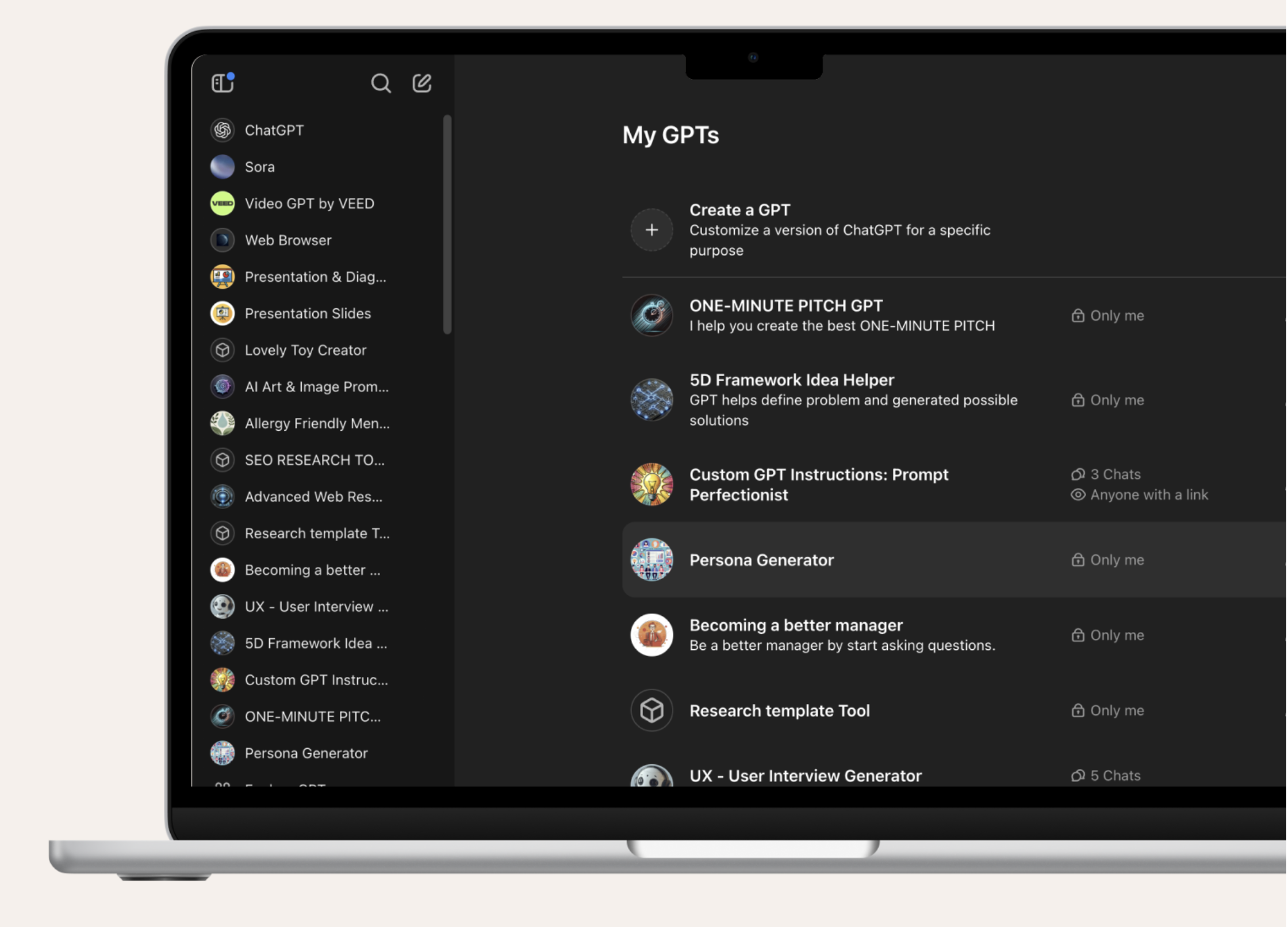
The Process
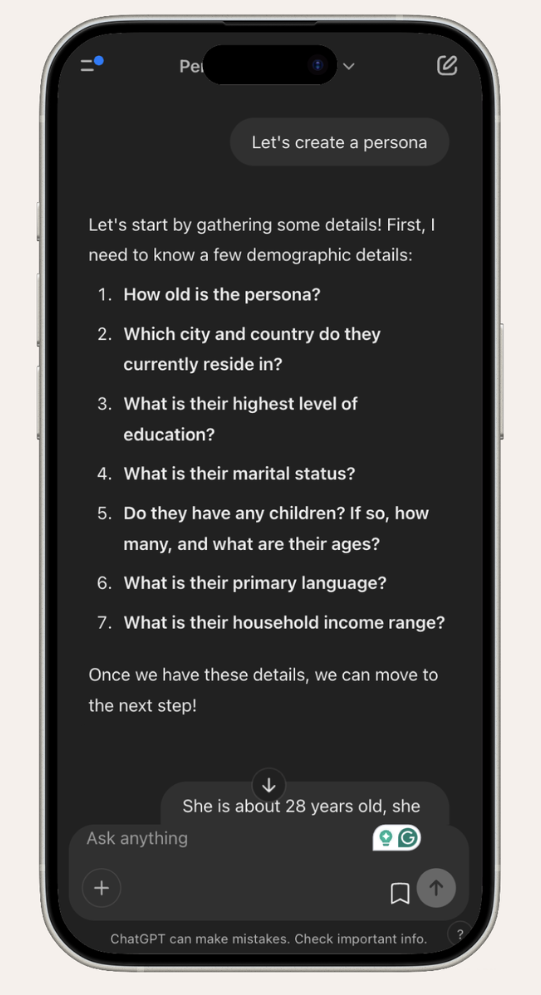
01 / Problem Framing
Most AI-generated personas failed in three critical ways:
Homogenization. Outputs converged toward predictable archetypes.
Lack of narrative depth. Personas lacked backstory, motivation, and internal tension.
Low engagement value. Teams struggled to emotionally or cognitively connect with them.
As a result, personas functioned as compliance artifacts rather than decision-shaping tools.
The core question became:
How might AI-generated personas achieve human-level specificity and narrative richness without sacrificing scalability?
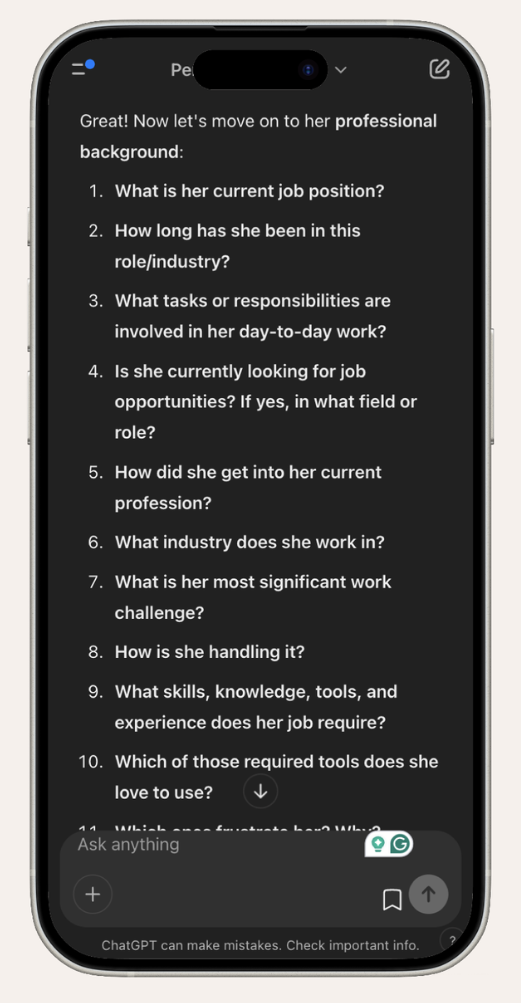
02 / Approach
Researched narrative psychology and character construction
Focused on how humans perceive uniqueness and credibility
Designed a structured question framework for human-centered AI design
Questions intentionally targeted:
Personal history, Contradictions and tensions, Motivations and fears, Contextual constraints
Applied prompt engineering principles: Sequencing, Constraint layering, Context preservation
Iterated through live testing
Compared outputs against standard AI persona generators
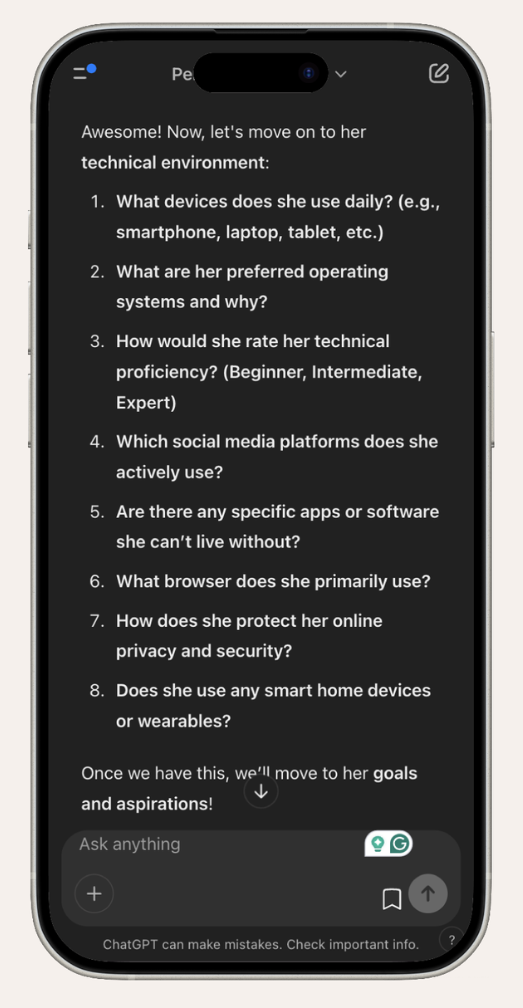
03 / Outcomes
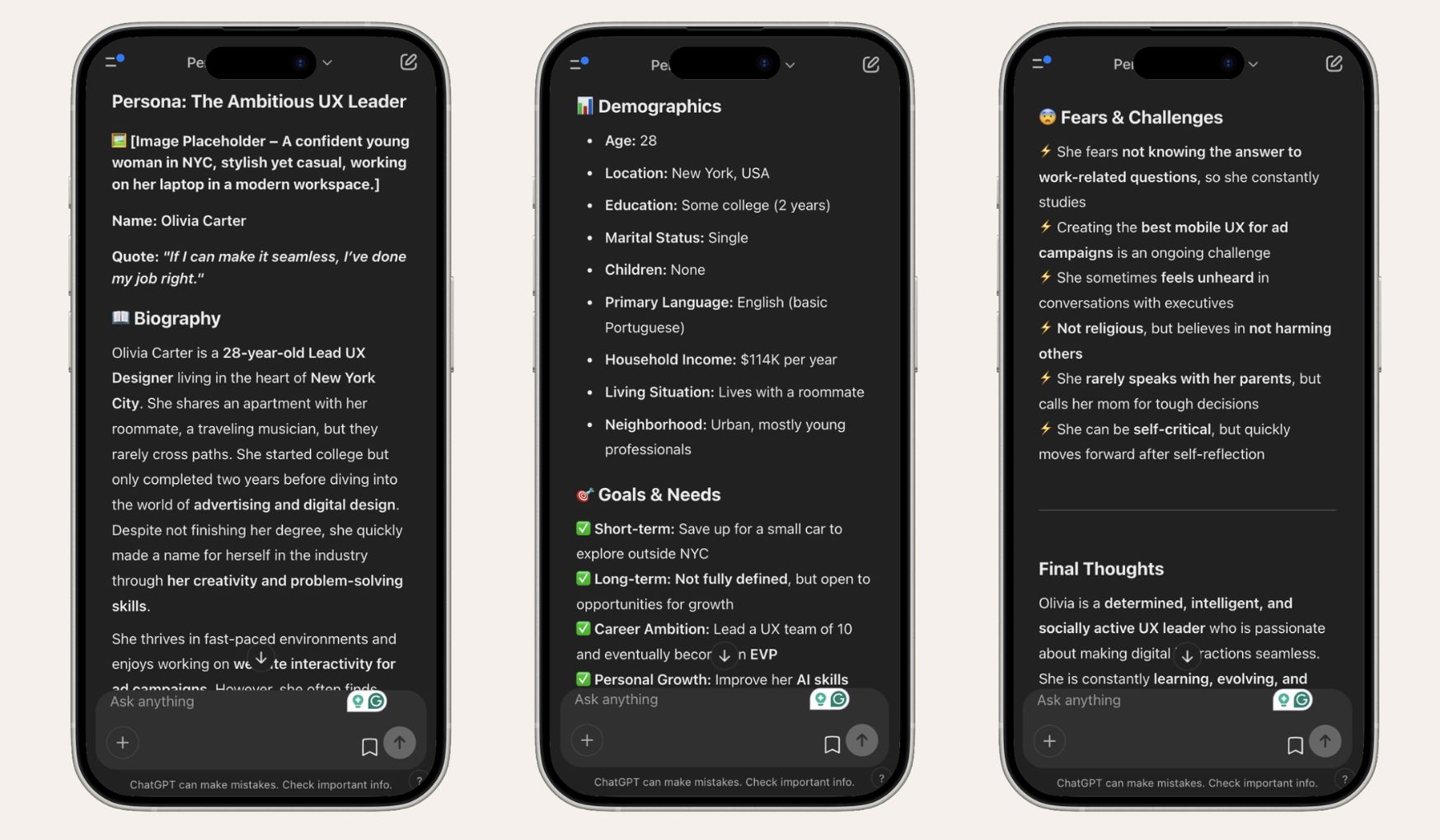
Generated personas that were:
Distinct, memorable, and internally consistent
More engaging for design critique and product ideation
Better aligned with empathy-driven UX research practices
Validated that prompt structure directly influences perceived human realism
Established a repeatable method for using AI as a UX research amplifier, not a shortcut
While not client-facing, this work demonstrated a transferable system applicable to: UX research and discovery, Product strategy validation, Early-stage concept testing, and AI-assisted DesignOps workflows
Why This Matters
This project is not about personas.
It is about how AI should be integrated into design practice.
It demonstrates that I:
Treat AI as a design material, not a magic box
Translate abstract AI capability into practical UX frameworks
Operate in ambiguity and self-direct learning into usable systems
Anticipate how AI tooling affects team behavior and design decision quality
For organizations building AI-forward product workflows, this reflects readiness to lead UX transformation, not follow trends.