SKIN app
Context
Pharmaceutical companies increasingly recognize that treatment effectiveness is influenced not only by medication but also by patient understanding, adherence, and communication with healthcare providers.
This project was initiated as an exploratory effort to design a patient companion application for individuals managing a skin condition. The goal was not diagnosis or clinical decision-making, but support, tracking, and shared understanding between patients and doctors.
The project operated under tight timelines and strict regulatory sensitivity, requiring careful abstraction and forward-looking technical planning.
The Process
01 / Problem Framing
Patients managing long-term treatments often struggle with:
Consistent tracking over time
Remembering subjective experiences such as pain, discomfort, or mood
Communicating progress clearly during medical follow-ups
Understanding whether changes are meaningful or incidental
At the same time, doctors lack longitudinal, patient-generated context and often rely on memory snapshots from short appointments.
The guiding question became:
How might we design a companion system that helps patients track their experience over time and enables clearer, data-informed conversations with their doctors?
02 / Approach
Exploratory Research and Concept Definition
I led early research to understand:
Patient behaviors around treatment adherence
Emotional and physical factors influencing engagement
Opportunities for technology to reduce cognitive and emotional burden
This informed a companion-first mindset, focused on support rather than control.
Feature Strategy
The app concept centered on four core capabilities:
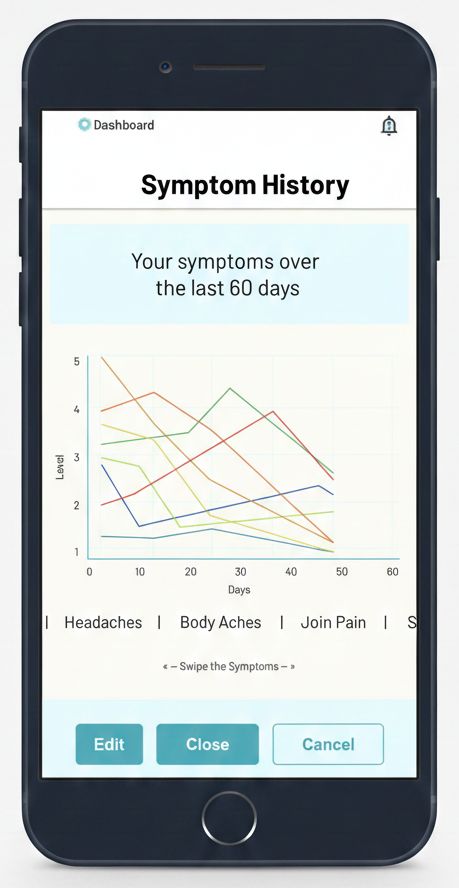
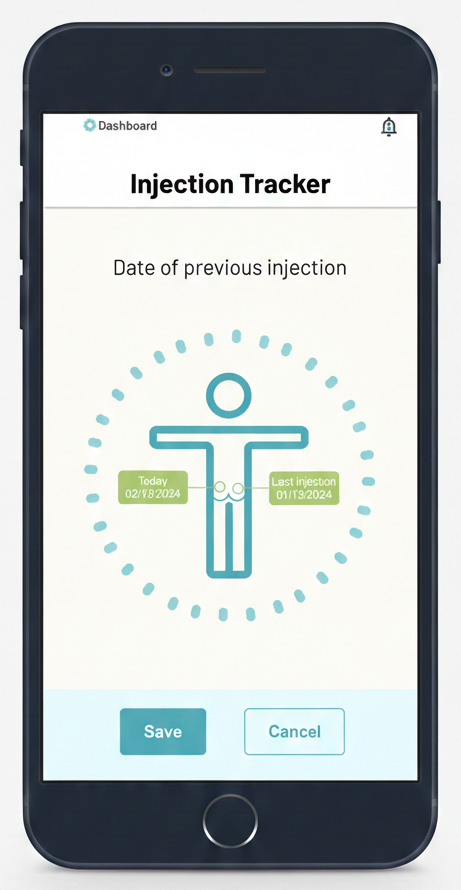
Treatment tracking
Simple, low-friction tracking to help patients stay consistentVisual progress monitoring
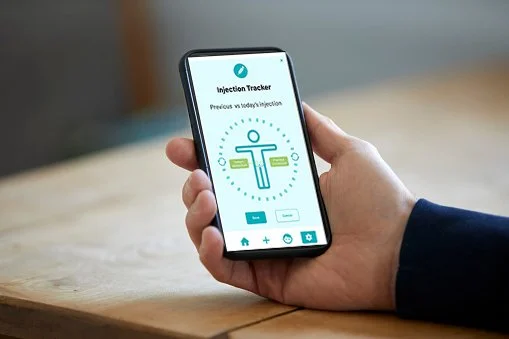
Patients could capture images over time, building a visual history that AI could later analyze for change detectionExperience journaling
Text and voice notes allowed patients to record mood, pain, and observations in their own wordsDoctor sharing and follow-up support
Patients could share summarized progress with their doctor ahead of appointments
The system was designed to accumulate meaningful longitudinal data, not isolated events.
AI Integration (Exploratory)
AI was planned as a supporting layer to:
Guide users in capturing consistent visual inputs
Detect changes over time across accumulated images
Surface patterns related to mood, pain, and progress
This was intentionally scoped as future-ready, acknowledging the novelty and regulatory sensitivity of AI in this space.
03 / Outcomes
Delivered a complete conceptual and UX foundation under tight deadlines
Prepared the product for technical feasibility discussions with the client’s development team
Established a scalable vision for AI-supported patient tracking
Demonstrated how UX can de-risk early-stage healthcare concepts before heavy investment
Although the project did not progress due to external delays, the strategy, structure, and system design were fully defined and owned by my UX team and me.
Why This Matters
These decisions balanced innovation with responsibility.
Companion, not clinician. The app supports patients without making medical claims.
Longitudinal over episodic data. Value emerges over time, not per interaction.
AI as augmentation. AI supports understanding but does not replace human judgment.
Privacy-aware abstraction. Design avoided unnecessary medical specificity.

This project highlights
my ability to:
Operate responsibly in regulated, high-stakes domains
Design systems that connect patients, technology, and professionals
Lead exploratory initiatives where outcomes are uncertain
Integrate AI thoughtfully from the outset, not as an afterthought
Deliver under pressure while maintaining strategic clarity
It reinforces my focus on simplifying complex problems into scalable, human-centered systems.